
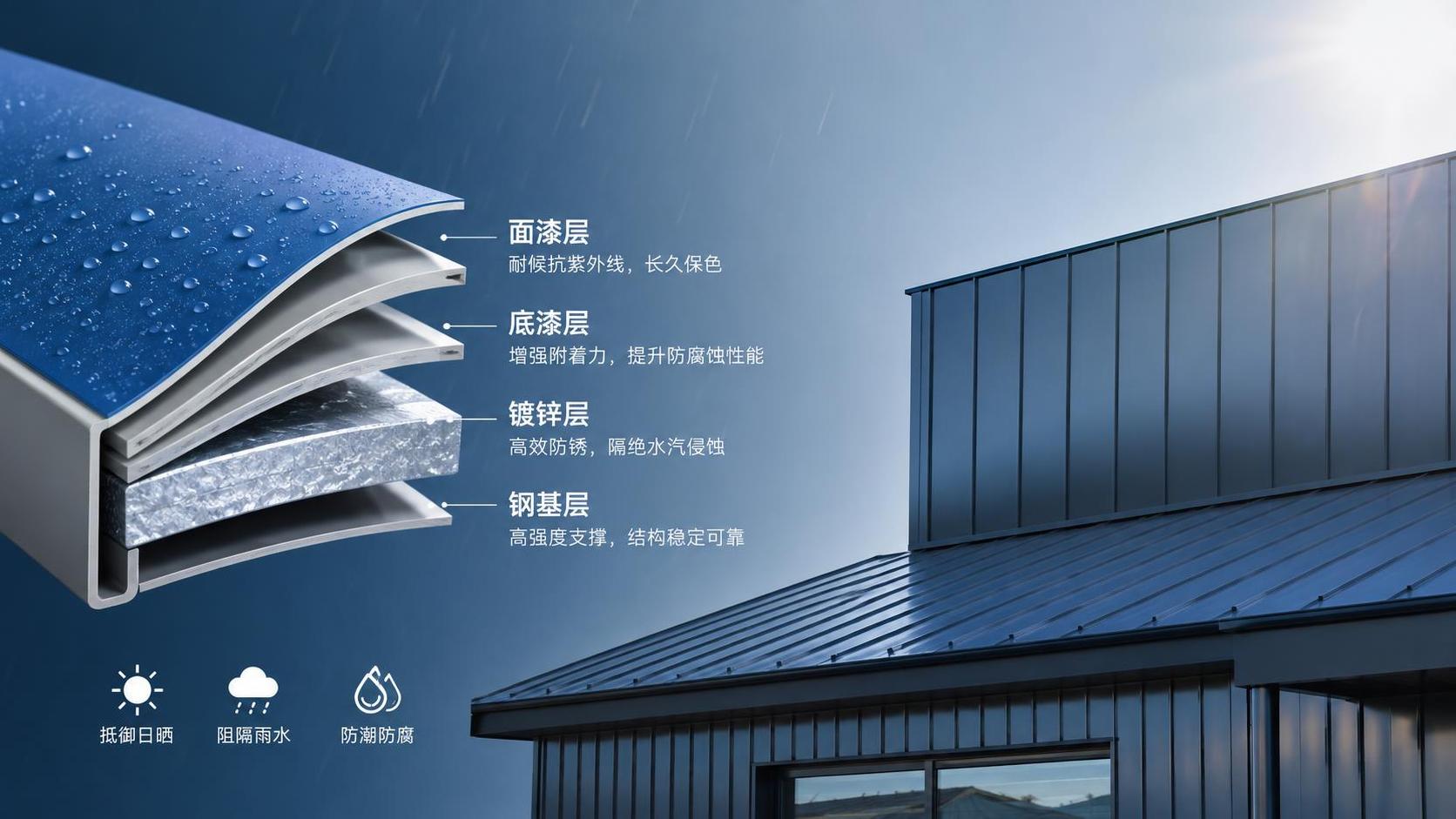
The outdoor life of prepainted galvanized steel depends heavily on the paint coating system, but coating thickness alone does not determine performance. A thicker film can provide a larger barrier to moisture and UV exposure, yet the expected service life still depends on coating chemistry, pretreatment, edge protection, forming damage, installation details, and the actual corrosivity of the site.
For quality and safety teams, this distinction matters because a visually acceptable PPGI Steel surface can still be vulnerable at cut edges, fastener holes, bends, scratches, and areas where water remains trapped. When coating failure progresses to corrosion, the consequence may extend beyond appearance: roof sheets can lose local integrity, cladding fixings can become less reliable, and maintenance work at height can become more frequent and less predictable.
A paint coating therefore should be assessed as part of a complete corrosion-protection system. The question is not simply whether a sheet is painted, but whether its metallic coating, pretreatment, primer, topcoat, reverse-side coating, fabrication method, and installed environment are compatible with the required outdoor life.
How the coating protects PPGI Steel outdoors
PPGI Steel typically combines several protective layers. The steel substrate is first protected by a metallic coating, commonly zinc-based. A chemical pretreatment is then applied to improve adhesion and corrosion resistance. Primer and finish coats are added before the coil is delivered for forming and installation. Each layer has a different job, and failure in one layer can reduce the value of the others.
The topcoat is the first line of defense against sunlight, rain, airborne contaminants, and routine handling damage. It limits water uptake and slows the path of corrosive agents toward the metal. It also determines many visible properties, including color retention, gloss retention, surface cleanliness, and resistance to chalking.
The primer is less visible but often decisive. A sound primer maintains adhesion between the pretreated metallic coating and the topcoat. It can also contribute corrosion inhibition when the coating is damaged or when moisture reaches an interface. If adhesion is weak, the topcoat may peel or delaminate even when its outward appearance initially seems satisfactory.
The zinc or zinc-alloy coating protects the substrate when a small defect exposes steel. Zinc can provide sacrificial protection in limited areas, slowing red-rust formation adjacent to a scratch. That protection is not unlimited. It becomes less effective where cut edges are broad, scratches are deep, moisture remains present, or the environment contains salts, industrial pollutants, or corrosive condensate.
For this reason, a paint film should not be treated as a permanent seal. Outdoor life is governed by how long the system can resist degradation and how well it controls corrosion after local damage occurs.
Coating chemistry changes the failure pattern
Different paint systems age differently outdoors. Selection should start with the exposure condition, rather than with a generic assumption that any prepainted coil is suitable for external use.
Polyester coatings are widely used where standard weather resistance and appearance are sufficient. They can be appropriate for moderate outdoor exposure, provided the substrate protection, film build, design details, and maintenance expectations are aligned. Their limits become more visible under intense UV, repeated wet-dry cycling, or atmospheres carrying chlorides and aggressive pollutants.
Silicone-modified polyester systems are often selected where improved weatherability is needed, particularly for exterior building components exposed to sustained sunlight. The degree of improvement depends on the actual formulation, so a coating family name should not replace a product-specific performance review.
Higher-durability fluoropolymer or PVDF-type systems are commonly considered when color stability and UV resistance are critical. Their use can be justified for highly visible facades, roofs with long design-life expectations, or locations where repainting would be disruptive. They are not automatically the answer to every corrosion problem. A highly weatherable topcoat cannot compensate for inadequate metallic coating mass, poor pretreatment, unsuitable cut-edge treatment, or an installation that traps contaminated water.
Polyurethane-based coatings may offer useful resistance to abrasion, chemicals, or mechanical damage in certain applications. Their suitability still depends on the complete exposure profile. A coating that performs well against physical wear is not necessarily the best option for prolonged UV exposure, coastal salts, or severe industrial fallout.
Quality specifications should therefore identify the required performance characteristics, not only a trade description. “Premium paint” is too vague for a purchasing or inspection decision. The coating type, nominal dry-film thickness, color and gloss requirements, reverse-side coating, applicable test methods, and the environmental assumptions behind the selection should be stated clearly.
UV exposure is an appearance issue before it becomes a protection issue
Sunlight gradually breaks down the binder in an organic coating. Early signs may include gloss loss and fading. With further exposure, chalking can occur as degraded resin leaves pigment particles at the surface. These changes are often treated as cosmetic, and in the early stages that may be reasonable. However, significant surface degradation can eventually reduce film cohesion, increase roughness, retain contaminants, and make cleaning less effective.
Color choice can influence both visual aging and thermal loading. Dark colors generally absorb more solar energy and can reach higher surface temperatures than light colors. Higher temperature cycles place additional stress on the coating, substrate, seams, and fastened joints. A dark finish is not inherently unsuitable, but it should not be specified without considering orientation, local climate, roof geometry, insulation, and the manufacturer’s approved application limits.
UV exposure also varies across a single installation. South- or west-facing surfaces in many locations receive greater solar stress than sheltered elevations. Roof panels may weather differently from vertical wall cladding because they receive more direct radiation, collect more deposits, and remain wet for longer after rainfall. Inspection plans should reflect those differences rather than treating all elevations as equivalent samples.
Moisture, deposits, and time of wetness drive corrosion risk
A coating’s outdoor life is often shortened less by occasional rain than by long periods of retained moisture. Condensation beneath roof sheets, blocked drainage paths, overlapping laps that hold water, and unventilated areas can keep a coating wet far beyond normal weather exposure. In those conditions, small coating defects become more consequential.
Salt is particularly important because it can attract and retain moisture. Coastal exposure is not limited to buildings directly beside the shoreline; wind direction, elevation, sheltering, and local deposition patterns can all affect chloride loading. Similarly, industrial emissions, agricultural chemicals, cleaning residues, and construction dust can create deposits that alter the surface environment.
Rain can wash some contaminants away, but sheltered zones may receive little natural cleaning. Under canopies, at eaves, behind equipment, near panel overlaps, and below drainage discharge points, deposits may accumulate while the surface remains intermittently wet. These are appropriate locations for targeted inspection because they frequently show early discoloration, blistering, edge corrosion, or coating adhesion problems.
Water run-off from dissimilar materials also deserves attention. Copper-containing run-off, incompatible sealants, untreated timber preservatives, and debris from adjacent components can create localized conditions that a general coating specification did not anticipate. The material selection review should cover interfaces, drainage routes, and maintenance chemicals, not only the exposed panel face.
Film thickness matters, but uniformity matters more than a single reading
Dry-film thickness is a useful control point because insufficient film build can reduce barrier protection and shorten weathering resistance. It should not be interpreted in isolation. A coating may meet an average thickness target while still containing thin zones, poor edge coverage, uneven curing, pinholes, or local damage from handling and forming.
For coil-coated material, the supplied coating thickness is measured before fabrication. Roll forming, bending, cutting, punching, and fastening can change the condition of the surface that ultimately faces the weather. Severe bends may create micro-cracking if the coating is not suited to the forming radius. Abrasive debris from cutting can damage nearby surfaces. A fastener driven with excessive force can fracture the film or distort the washer seal.
Inspection should distinguish between factory quality and installed quality. Both are necessary, and neither is a substitute for the other.
Acceptance criteria should define where measurements are taken and how variability is handled. A single thickness result from an accessible flat area says little about bent profiles, panel edges, repair zones, or hidden surfaces. Where performance is safety-critical, inspection records should link findings to panel location and exposure conditions so that recurring issues can be identified before extensive replacement is needed.
Cut edges are often the practical limit of outdoor durability
Coil coating protects broad faces efficiently, but field-cut edges expose the cross-section of the steel and metallic coating. The zinc layer can provide some sacrificial action near the cut, yet edge corrosion remains a common long-term concern, especially where moisture and contaminants collect.
The visible top surface can remain in good condition while corrosion advances from an edge, overlap, or concealed lap. Rust staining at a lower edge may indicate that the source is above or behind the visible stain. Inspection should therefore avoid judging panel condition only by accessible face surfaces.
Edge treatment requirements depend on design, exposure, and expected service life. Some systems rely on the metallic coating and drainage design; others require field-applied edge protection, sealants, or more durable construction details. The decision should be made before installation. Applying a generic touch-up paint after corrosion is already established may improve appearance without restoring the original protection system.
Touch-up materials also require control. Their color, chemistry, adhesion, cure condition, and compatibility with the factory coating matter. Large repaired areas should prompt an investigation into the cause of damage rather than becoming an accepted substitute for proper handling.
Common assumptions that lead to weak specifications
One common assumption is that a thicker topcoat always produces a proportionally longer service life. Additional thickness may be beneficial, but it cannot resolve poor drainage, high chloride exposure, insufficient substrate protection, or failures at cut edges and fasteners. The most effective improvement may be a change in coating system, metallic coating, panel geometry, or installation practice rather than a small increase in paint thickness.
Another is that a coating described as UV-resistant is automatically suitable for outdoor corrosion protection. UV resistance relates primarily to resistance against fading, chalking, and loss of surface appearance. Corrosion performance also relies on film permeability, adhesion, pretreatment, metallic coating, and the severity of moisture and contaminants.
A third assumption is that a factory-applied finish eliminates the need for maintenance. PPGI Steel reduces maintenance demands when it is properly selected and installed, but it still needs periodic observation. Cleaning may be appropriate where deposits are likely to remain. Damage from roof access, equipment installation, impact, or modifications should be repaired promptly under a defined procedure.
Finally, test certificates should not be read as a direct prediction of years in service. Laboratory testing is useful for comparing materials and confirming conformance to specified methods, but an installed building sees combined stresses: solar radiation, standing water, dirt retention, thermal movement, salt deposition, mechanical damage, and maintenance activity. The environmental assumptions behind a test result must match the proposed application.
How quality and safety teams can turn coating data into a usable decision
A practical review begins by classifying the exposure. Consider whether the product will be used on a roof, wall, enclosure, guard, equipment housing, or external access structure. Identify direct sun, prevailing wind, salt or pollutant exposure, condensation risk, drainage behavior, chemical contact, cleaning practices, and the difficulty of future access. The cost and safety implications of repair can be as important as the initial material cost.
Then review the full material system. The specification should cover the steel substrate, metallic coating, pretreatment, primer, topcoat, reverse-side coating, film thickness, color, gloss, surface texture, and fabrication limits. For formed products, confirm the permitted bend radius and any restrictions on cutting, punching, welding, or post-coating repair.
During installation, focus on details that can defeat an otherwise suitable coating:
- Keep drainage paths open and prevent ponding at laps, penetrations, gutters, and low points.
- Remove cutting swarf and metallic debris before they create rust spots or scratch the finish.
- Control fastener installation so that panels, washers, and coatings are not damaged by overdriving.
- Use compatible sealants, flashings, cleaning agents, and adjacent materials.
- Record and assess coating damage, rather than allowing extensive field touch-up to become routine.
- Inspect concealed edges, penetrations, and sheltered areas as part of planned maintenance.
For safety managers, the inspection interval should reflect both exposure severity and the consequence of failure. A decorative wall panel and a corroding roof sheet above an occupied work area do not carry the same risk. Locations requiring repeated access for inspection or repair should also be reviewed for fall protection, access routes, fragile-surface hazards, and the possibility that corrosion may weaken the supporting or cladding system before it is visible from ground level.
Specify performance around the actual exposure
The paint coating on PPGI Steel has a direct effect on outdoor life because it controls the first stages of weathering and delays corrosion of the protected metal. Its value is realized only when the coating system fits the site, the substrate protection is adequate, fabrication does not compromise the finish, and installation avoids persistent moisture and incompatible interfaces.
A sound specification therefore asks more than “what paint is on the sheet?” It asks where water will sit, how long the surface will stay wet, what will reach the coating, where damage is most likely, and whether the remaining protection at those locations is adequate for the required service period. Those questions produce a more reliable basis for material approval, inspection planning, and long-term safety control than coating appearance alone.
Get real-time quotes
Interested? Leave your contact details.