
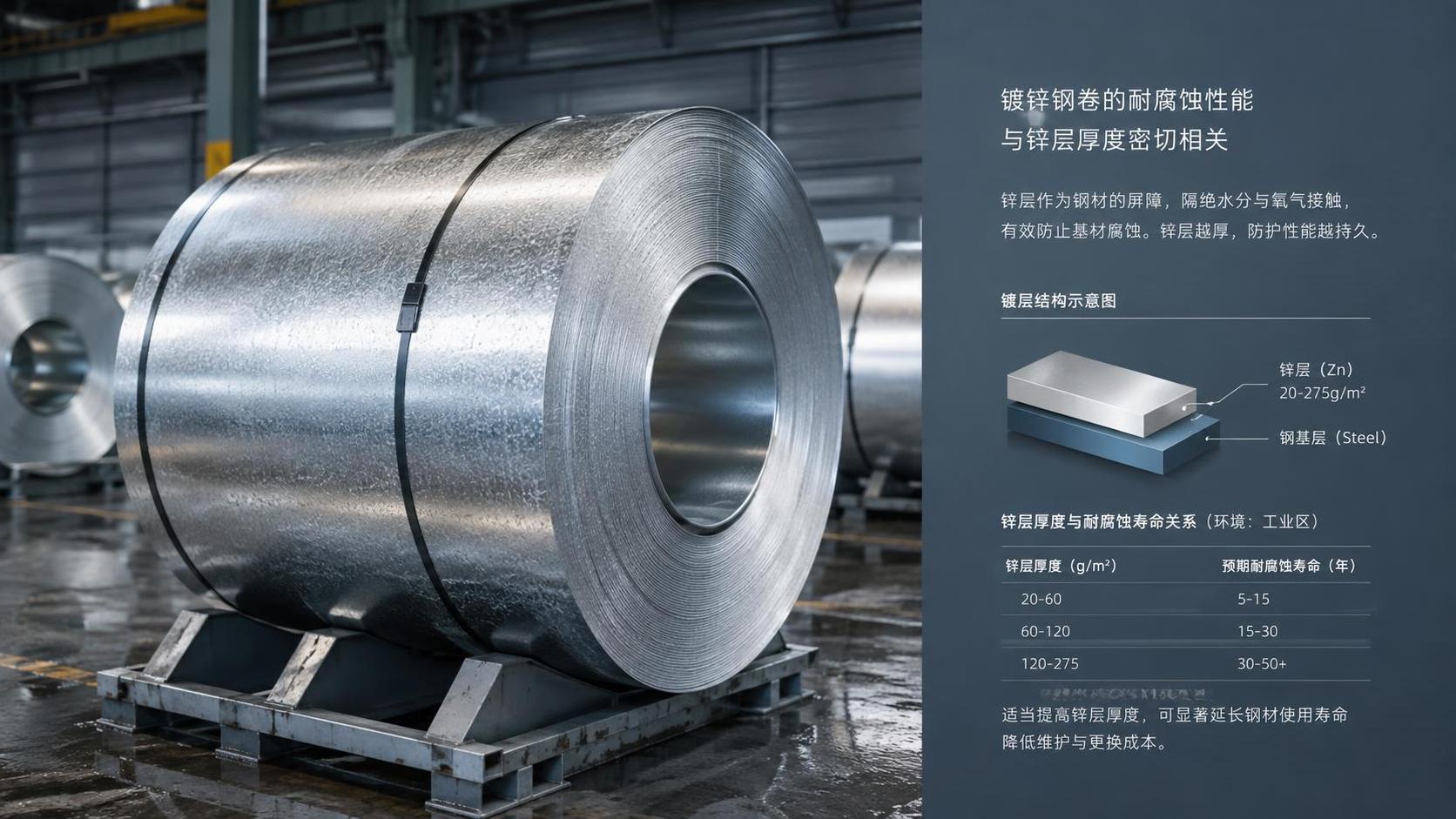
When Zinc Coating Thickness Actually Matters in Galvanized Steel Coils
For buyers of Galvanized Steel Coils, zinc coating thickness is often treated as a simple “more is better” specification. In practice, that approach can lead to unnecessary cost, processing problems, or a coil that looks compliant on paper but performs poorly in service. The right coating level depends on where the finished part will be used, how it will be formed, whether edges are exposed, how long it is expected to last, and what the next coating system will do.
A roof panel in a humid industrial area, a roll-formed stud inside a dry building, an agricultural equipment component, and a painted appliance panel may all start with galvanized sheet. They should not automatically receive the same zinc coating requirement. Procurement decisions become more reliable when coating thickness is viewed as part of the whole material system rather than as a standalone number.
The first practical point is terminology. In many specifications, zinc coating is stated as coating mass rather than physical thickness. For example, EN 10346 commonly uses designations such as Z100, Z180, or Z275, where the number generally refers to the nominal total zinc coating mass on both sides in grams per square metre. ASTM A653 uses designations such as G60 or G90, expressed in ounces per square foot for both surfaces. G90 is commonly associated with approximately 275 g/m² total coating mass, although buyers should always review the applicable standard edition and testing basis before treating designations as interchangeable.
That “both sides” detail is easy to miss. A Z275 coil does not normally mean 275 g/m² on each face. If coating were distributed evenly, its average zinc thickness would be roughly 19 microns per side. Actual coating distribution, surface condition, and measurement method can vary, which is why a purchasing specification should state the governing standard instead of relying only on a verbal request for “heavy galvanized coating.”
Corrosion exposure is the real starting point
Zinc protects steel in two ways. It forms a barrier between steel and the environment, and it provides sacrificial protection where small scratches or cut edges expose the substrate. More zinc generally means a longer period before the coating is consumed. But the rate at which zinc is consumed is governed by the environment, not by the coil’s label alone.
Indoor, dry, conditioned spaces are very different from wet storage areas, coastal sites, livestock buildings, chemical-processing surroundings, or locations affected by road de-icing salts. Moisture retained in joints, deposits trapped under overlapping panels, and repeated wet-dry cycles can be more damaging than open exposure. A component may be installed indoors yet still experience condensation every day. That is often more relevant than the building’s postal address.
For low-corrosion interior applications, a moderate zinc coating may be commercially sensible and technically adequate. Specifying an unusually heavy coating for concealed framing or short-life packaging-related use can add material cost without changing the service outcome. On the other hand, reducing the coating mass on exterior cladding, agricultural structures, drainage-related components, or unpainted outdoor fabrications can create a failure risk that will not show up during incoming inspection.
The buyer should ask a more useful question than “What coating does your supplier normally offer?” Ask: What exposure will the finished component see after forming, installation, and maintenance conditions are taken into account? The answer should include expected wetness, contaminants, temperature cycling, contact with dissimilar materials, and whether the product will be painted.
Thicker coating does not always form better
Galvanized Steel Coils are frequently roll formed, pressed, deep drawn, bent, slit, welded, or punched. A heavier zinc layer can improve corrosion reserve, but it may require more attention during processing. The coating is metallurgically bonded to the steel, yet severe deformation can still create surface roughness, powdering, flaking, or cracking if the coil grade, coating type, tooling, lubrication, and bend geometry are poorly matched.
This is especially relevant for parts with tight radii, complex press-forming operations, or cosmetic surface requirements. A buyer who selects a high coating mass purely for durability may later find that the forming line needs adjustment, the surface appearance changes after bending, or paint preparation becomes less consistent. These are not arguments against heavy galvanizing. They are reasons to qualify it with the actual processing route.
Coil chemistry and mechanical properties matter here as much as coating mass. A commercial-quality sheet intended for simple bends is not the same material as a drawing-quality or structural-grade coil. Likewise, conventional zinc coating, zinc-aluminium-magnesium coating, galvannealed steel, and prepainted galvanized products do not behave identically in forming or finishing. A procurement document that specifies only base metal thickness and zinc mass leaves too much room for assumptions.
Where coating thickness becomes a processing issue
- Tight-radius bends or severe press forming, where coating adhesion and surface condition should be checked through trials.
- Roll-forming lines that run at high speed and are sensitive to friction, pickup, or variation in coil surface texture.
- Visible painted components, where spangle, roughness, pretreatment, and paint adhesion may matter more than simply increasing zinc mass.
- Resistance welding or other joining operations, where coating weight can affect electrode wear and process settings.
- Slit or cut-edge-heavy products, because cut edges need a realistic corrosion strategy rather than blind reliance on nominal face coating.
A short production trial can be worth far more than a small saving negotiated per tonne. This is particularly true when changing from one mill source to another, even if both materials carry the same coating designation.
Compare coating specifications before comparing prices
Coating mass is a frequent source of misleading price comparisons. One quotation may state Z275 under EN 10346, another may state G90 under ASTM A653, and a third may simply say “275 g/m².” Those descriptions can point in a similar direction, but they are not a complete technical comparison. The relevant standard defines not only the designation, but also the testing approach, permissible variation, mechanical-property references, and sometimes surface or delivery conditions.
Buyers should also distinguish between nominal coating mass, minimum coating mass, single-spot results, and multi-spot average results. A coil may meet a standard’s acceptance criteria while showing normal local variation across its width or length. If a project has an unusually sensitive corrosion requirement, a generic coating code may not be enough. The purchase order may need to identify the required standard, coating designation, test method, side-specific requirement where relevant, and documentation expected at delivery.
Pay attention to coil weight, yield, and project economics
A thicker zinc coating adds metal and therefore adds weight. For projects bought by tonne but consumed by area, this can affect yield calculations. Two coils with the same substrate thickness and width may not produce exactly the same covered area if coating masses differ. The difference may be modest in some applications, but it should not be ignored in high-volume roofing, ducting, framing, or fabricated-panel programmes.
The cheapest coil price is not always the lowest installed cost, but the heaviest coating is not automatically the best lifecycle decision either. A sensible evaluation weighs zinc cost against expected corrosion exposure, repainting access, failure consequences, fabrication loss, and the practical life of the asset. A replaceable indoor bracket and a difficult-to-access exterior panel should not be priced using the same risk logic.
There is also a supply-chain consideration. Not every mill, coating line, or regional source offers every grade-coating-width combination on the same lead time. If a specification is unnecessarily narrow, the buyer may reduce competitive sourcing options without gaining usable performance. Where the end-use allows it, defining an acceptable coating range or approved equivalent standard can improve purchasing flexibility. That should be done carefully, with engineering agreement, rather than treated as a commercial substitution after the order is placed.
Common mistakes in galvanized coil selection
One recurring mistake is assuming all zinc coatings described as “galvanized” have the same corrosion behavior. Coating composition, surface treatment, post-treatment, paint system, edge design, and installation environment all influence the result. Another is specifying a coating designation without naming the standard. This can create disagreements later when inspection data are reviewed.
Buyers also sometimes focus on the broad face of the sheet and overlook details where corrosion starts: drilled holes, hems, overlaps, fastener locations, weld zones, poorly drained channels, and cut edges. In real fabrication, those features frequently decide whether a galvanized product ages gracefully or stains and rusts early. Better detailing may provide more value than adding zinc mass beyond what the environment actually requires.
Finally, avoid treating mill certificates as a substitute for incoming control. Certificates are essential, but receiving checks should still confirm coil identity, dimensions, visible surface condition, packaging integrity, and traceability. If coating verification is required, the method and sampling plan should be agreed before delivery. Disputes are much easier to resolve when the contractual acceptance basis is clear.
A practical specification route
A durable procurement specification for Galvanized Steel Coils normally starts with the finished application, then works backward. Define the exposure level and service expectation. Confirm whether the product will be bare, painted, enclosed, drained, or regularly wetted. Identify the forming and joining operations. Then select the substrate grade, nominal thickness, coating designation, surface condition, dimensions, tolerance requirements, and governing standard as one package.
When requirements are uncertain, it is usually better to request technical comparison from qualified suppliers than to copy a coating code from an old purchase order. Old specifications often reflect a previous mill source, a different installation environment, or an over-conservative choice made to avoid a past complaint. They are useful references, not automatic answers.
Zinc coating thickness matters most when corrosion exposure, access for maintenance, and the cost of failure are high. It matters less when the steel is protected by a well-designed finishing system in a controlled environment. The purchasing decision becomes stronger when it is based on the actual service conditions and manufacturing route—not on the assumption that the highest coating number is always the safest choice.
Get real-time quotes
Interested? Leave your contact details.