
Why Impact Toughness Matters for Steel Plates in Cold Climates
In cold-climate projects, selecting the right Steel Plates is not simply a matter of strength or thickness. As temperatures fall, steel can lose ductility and become more vulnerable to brittle fracture under impact loading. For project managers and engineering leaders, understanding impact toughness is essential for protecting structural integrity, controlling risk, and meeting performance requirements. This article explains why impact toughness matters and how it influences reliable steel plate selection for demanding low-temperature applications.
This issue often becomes visible late in a project, when material has already been ordered or fabricated. A plate may meet the specified yield strength, tensile strength, and thickness tolerance, yet still be unsuitable for a winter-exposed structure, a refrigerated process unit, or equipment operating in sub-zero service. Strength tells part of the story. It does not, by itself, show how the material will behave when a sudden load reaches a weld toe, a bolt hole, a plate edge, or a small fabrication defect at low temperature.
For a project team, the practical question is not merely whether a steel grade is “strong enough.” It is whether the selected plate has sufficient resistance to crack initiation and crack propagation under the actual combination of service temperature, loading condition, plate thickness, weld detail, restraint, and inspection quality.
Cold changes the way steel fails
Many carbon and low-alloy steels show a transition in behavior as temperature decreases. At relatively moderate temperatures, they can absorb energy and deform before failure. As the temperature drops, some steels become less able to deform plastically. Under unfavorable conditions, failure can become sudden and brittle rather than gradual and ductile.
That distinction matters because brittle fracture offers very little warning. A ductile component may bend, elongate, or visibly distort before it fails. A brittle fracture can travel rapidly through a stressed section, particularly where a notch, weld imperfection, sharp geometry, or pre-existing crack concentrates stress. The material may have performed acceptably for a long period, then fail during a cold start, a pressure fluctuation, impact event, lifting operation, or abrupt shutdown.
Steel Plates used in bridges, crane structures, offshore modules, storage tanks, mining equipment, heavy transport frames, and process facilities are not all exposed to the same risk. Still, the pattern is familiar: low temperature reduces the margin for error. Details that are manageable in warm service can become critical when the plate temperature falls below the assumptions used during material selection.
Impact toughness is a practical measure of damage tolerance
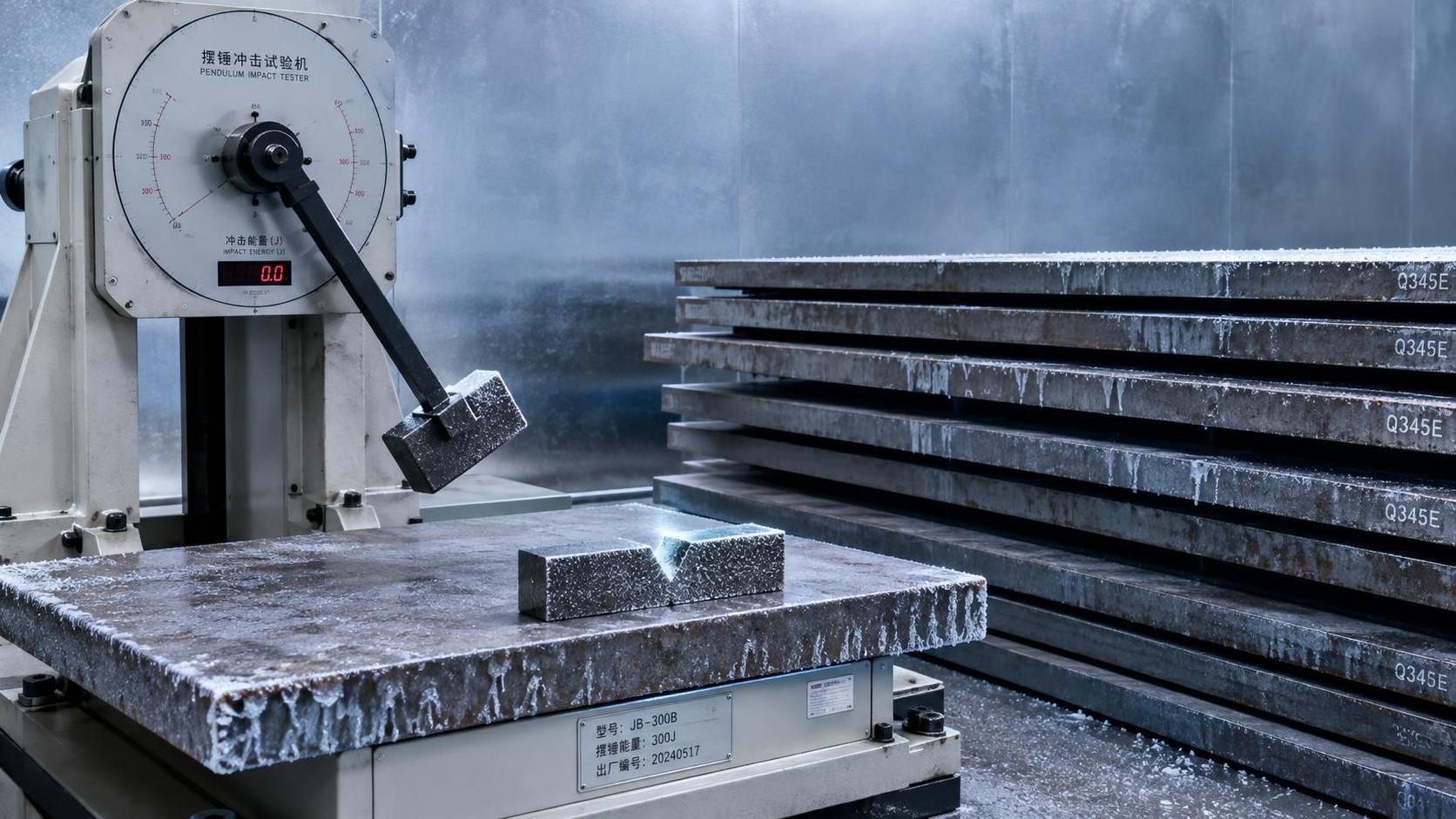
Impact toughness describes a material’s ability to absorb energy during rapid loading before it fractures. In steel procurement and quality documentation, this property is commonly assessed using a Charpy V-notch impact test. A notched specimen is struck by a pendulum, and the energy absorbed at a stated test temperature is recorded.
The Charpy test is not a full simulation of a finished structure. It does not reproduce every plate thickness, weld geometry, residual stress condition, or service load. But it provides a useful and widely recognized indication of how a steel grade may respond to notch-sensitive fracture conditions. The test temperature is as important as the reported impact value. A result obtained at room temperature does not demonstrate equivalent behavior at a lower project design temperature.
This is where specification reviews can go wrong. A purchase order may state a plate grade and nominal strength class but omit the required impact test temperature, testing direction, or acceptance criterion. The supplier may then provide material that meets the basic grade standard while not meeting the project’s actual cold-service requirement. Nothing may be technically “wrong” with the plate; the requirement was simply incomplete.
Why a small defect becomes more serious in winter
Structural steel rarely exists in a perfectly smooth, stress-free state. There are weld transitions, cope holes, cut edges, attachments, temporary lifting lugs, intersections of stiffeners, and local changes in section. Fabrication introduces residual stress. Field assembly can add misalignment or restraint. These conditions do not automatically create a failure, but they reduce the tolerance for low toughness.
A notch-sensitive steel plate under cold conditions may not redistribute stress effectively around a local discontinuity. Instead of yielding locally, it may crack. The risk is higher where loading is dynamic, cyclic, or sudden. Typical examples include impact from handling equipment, wind-induced movement, vibration from rotating machinery, starting and stopping of heavy loads, or pressure changes in process systems.
Thickness also deserves attention. Thicker sections can experience greater through-thickness restraint and may cool differently from thin material. They also tend to be used in higher-consequence locations: heavily loaded nodes, base plates, lifting components, pressure-retaining shells, and primary structural connections. It is risky to assume that a toughness requirement suitable for a thin plate is automatically adequate for a much thicker one.
The service temperature is not always the weather forecast
One of the most useful early-stage discussions is the definition of minimum design metal temperature. It should not be reduced to the lowest reported outdoor air temperature at the jobsite. Plate temperature can be influenced by wind, radiation, insulation, contact with cold process media, startup conditions, and operational shutdown scenarios. A vessel or structural member located indoors may still see low metal temperatures if it handles refrigerated fluids. Conversely, a component outdoors may not always reach the lowest ambient temperature, depending on its duty cycle and thermal mass.
The correct design temperature therefore needs input from structural, process, mechanical, and operations teams. This is particularly true where the equipment can depressurize, where cold product enters intermittently, or where maintenance exposes normally protected components. If the temperature basis changes after procurement, it may be difficult to correct with paperwork alone.
It is also worth separating normal service from credible upset conditions. Not every rare scenario should drive the most demanding material requirement, but neither should a low-probability cold event be dismissed without engineering review. The consequence of failure, accessibility for inspection, and ability to shut down safely all affect the decision.
Strength grade and toughness grade are not interchangeable
Higher-strength Steel Plates can be attractive because they may allow lighter structures or smaller section sizes. That can reduce fabrication weight, transport cost, and installation loads. Yet a higher strength designation does not automatically mean better low-temperature toughness. Depending on the grade, plate thickness, delivery condition, and governing standard, the toughness requirements can vary significantly.
This is why a project team should resist a simple “upgrade the strength” approach when a cold-service concern is identified. The better solution may be a grade with a suitable tested toughness class, a different delivery condition, a revised plate thickness, or changes to a connection detail. In some cases, a more moderate strength level with dependable low-temperature impact properties is the more sensible engineering choice.
Common steel standards provide different ways of designating impact properties. For example, standards in the EN 10025 family use grade suffixes that can indicate specified impact testing conditions, while ASTM material specifications may state impact requirements separately or rely on supplementary requirements depending on the product and application. The exact interpretation must come from the applicable edition of the project specification and material standard. Grade names alone are not enough for a release decision.
What should be specified before ordering plate
The best time to manage toughness is before the request for quotation is issued. By the time a mill test certificate arrives, the project may have little flexibility. A clear material requisition should connect the plate requirement to the intended service rather than asking procurement to infer engineering intent.
At a minimum, the technical team usually needs to establish the following points:
- Minimum design metal temperature, including relevant operating and upset conditions.
- Required impact test temperature and acceptance requirement under the applicable standard or project specification.
- Plate thickness range, because impact requirements and material behavior can be thickness-dependent.
- Whether testing is required in the longitudinal, transverse, or another specified orientation.
- Delivery condition, such as normalized, normalized rolled, thermomechanically rolled, or quenched and tempered, where relevant to the selected grade.
- Any additional controls for through-thickness properties, ultrasonic testing, lamellar tearing risk, or weldability.
- Documentation requirements, including the level of inspection certificate and traceability expected by the project.
These items should not be copied mechanically from a previous project. A plate for a low-temperature equipment support has different priorities from plate used in a pressure boundary, an arctic conveyor frame, or a heavily welded offshore component. Reusing an old specification can be efficient, but only after confirming that the previous temperature basis, loading assumptions, and code requirements still apply.
Welding can either preserve or undermine the toughness decision
Selecting a tough plate is not the end of the story. The heat-affected zone beside a weld can have different properties from the parent plate. Welding procedure selection, heat input, preheat, interpass temperature, consumable choice, joint restraint, and post-weld treatment can all influence low-temperature performance.
For cold-service fabrication, the welding procedure qualification should be aligned with the same low-temperature intent as the base material. It is not enough to confirm that a weld procedure produces acceptable strength at ambient conditions if the final assembly will be exposed to low temperatures and notch-sensitive loading. Where the governing code or project specification requires weld impact testing, that requirement should be identified early, especially before fabricators commit to procedures and consumables.
Field modifications deserve particular caution. A seemingly minor added bracket, repaired weld, or flame-cut opening can alter stress flow and introduce local hardness or residual stress. In a cold environment, those changes may deserve engineering review rather than being treated as routine site work.
Material certificates need a technical review, not a paperwork check
Mill test certificates are often reviewed quickly because the chemical composition and tensile values appear familiar. For low-temperature applications, the impact section should receive equal attention. Confirm that the test applies to the actual heat, plate thickness, and required condition. Check the stated test temperature, specimen orientation, individual values where reported, and the applicable acceptance basis.
A certificate can be valid while still being unsuitable for the intended use. For example, impact results at a warmer temperature than the project requirement cannot simply be assumed to satisfy colder service. Similarly, a certificate from a different plate thickness or a generic product family document is not a substitute for heat- and plate-specific evidence when traceability is required.
Project managers do not need to become metallurgists, but they should make sure there is a defined technical gate between purchasing and fabrication. The review should involve the party responsible for materials engineering, structural design, or code compliance, rather than relying solely on commercial equivalency.
Where teams commonly lose control of the risk
The most common problem is treating impact toughness as an optional upgrade after the plate grade has been chosen. Another is assuming that all material described as “low-temperature steel” is interchangeable. The actual suitability depends on the specified test temperature, energy requirement, thickness, manufacturing route, and intended application.
Substitution is another pressure point. If the originally specified plate is unavailable, an alternate grade may be proposed based on similar strength and chemistry. That can be a reasonable route, but it requires a proper comparison of certified toughness performance, weldability, delivery condition, dimensions, and code acceptance. A commercial substitution should never bypass the engineering review simply because the substitute is described as equivalent.
Finally, avoid assuming that a large safety factor in structural capacity solves brittle-fracture risk. Extra thickness may improve nominal load capacity, but it does not automatically correct poor toughness, unfavorable weld details, or a mismatch between tested material performance and service temperature.
A better decision path for cold-climate Steel Plates
Reliable selection begins with the coldest credible metal temperature, not with a familiar plate designation. From there, identify the loading characteristics, consequence of failure, plate thickness, joint configuration, welding approach, and governing code or customer specification. Only then can the required impact toughness level be translated into a procurement requirement that a mill and fabricator can actually verify.
This approach may add a few careful discussions at the start of a project. It usually costs far less than resolving a rejected certificate, redesigning a connection after fabrication, or explaining why a structurally strong plate cannot be released for winter service. In cold climates, the right Steel Plates are not defined by strength alone. They are defined by how reliably they retain fracture resistance when temperature, loading, and real-world imperfections begin working against them.
Get real-time quotes
Interested? Leave your contact details.